
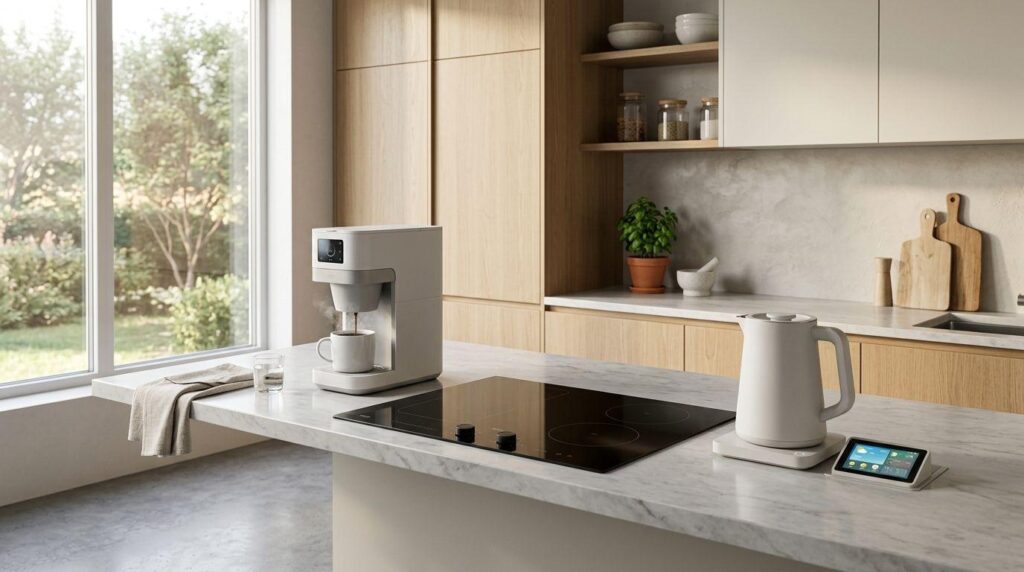
A kitchen rarely feels chaotic because of one big mess. It’s usually a slow accumulation of small frictions: a counter that never quite clears, a cupboard door that won’t close, an appliance front that visually competes with everything around it. Smart kitchen appliances and thoughtful daily habits both play a role in whether a kitchen feels calm or chaotic by the end of a long week. This article looks at where that sense of order actually comes from, starting with everyday routines and moving toward the physical layout and design choices that either support or undermine them.
Key Takeaways
- Visual clutter in a high-traffic space like the kitchen can lower a person’s sense of control over the rest of the day.
- Grouping tools and ingredients by task, rather than by category, cuts down on decision fatigue during meal prep.
- A short nightly reset habit prevents small messes from compounding into a weekend-long cleanup.
- Appliance placement shapes walking paths, while appliance fronts influence how “busy” a kitchen looks even when it’s clean.
- Smart kitchen appliances with concealed or integrated designs can reduce visual noise without requiring a full renovation.
Why kitchen clutter affects daily calm
The kitchen tends to be the most frequently used room in a home, which means small inefficiencies get repeated dozens of times a day rather than once. A drawer that sticks, a spice rack in the wrong spot, or a counter that’s perpetually half-covered doesn’t just cost a few seconds each time — it accumulates into a background hum of low-grade friction that people notice even when they can’t name it.
There’s also a perceptual layer to this. A visually busy surface, with mismatched containers, exposed cords, and stacked mail, gives the eye nowhere to rest. Because the kitchen is usually visible from the living or dining area in open-plan homes, that visual noise doesn’t stay contained; it bleeds into how the whole downstairs feels. People often describe walking into a cluttered kitchen in the morning as immediately more tiring than walking into a tidy one, even before any actual task begins.
This isn’t purely aesthetic. A cluttered workspace forces small, repeated decisions — where to put this, what to move to reach that — and each of those micro-decisions draws on the same limited attention a person needs for the rest of the day. A kitchen that requires less negotiation to use tends to leave more mental bandwidth for everything that follows.
Small habits that create lasting order
Long-term kitchen order rarely comes from one big cleanup; it comes from small habits repeated consistently. One of the most effective is zone-based storage: grouping items by the task they support rather than by what they technically are. Coffee mugs, filters, and the kettle live near each other because they’re used together, not because “mugs” and “kettle” belong in separate logical categories. This matters because it removes the small searching-and-fetching steps that add up during a rushed morning, and it means muscle memory can take over instead of conscious thought.
A second habit worth building is a short nightly reset: clearing counters, loading the last dishes, and returning stray items to their zones before the day ends. The mechanism behind this is straightforward — clutter compounds faster than it accumulates in a straight line. A single unwashed pan left overnight makes it easier to leave two the next night, and by the end of a week, the kitchen requires a much larger effort to restore than if it had been reset daily. Breaking that chain early keeps the required effort small and consistent rather than occasional and overwhelming.
A useful way to think about these habits is as guardrails rather than rules. The goal isn’t a spotless kitchen at every moment, but a system where returning to order takes minutes, not hours. When zones are logical and the reset habit is in place, even a busy week doesn’t produce the kind of backlog that makes a Saturday morning feel like a chore. The habit does the maintenance so no single day has to.
How appliance design shapes kitchen flow
Habits only go so far if the physical layout works against them. Appliance placement directly affects the walking path a person takes while cooking, and an inefficient path adds friction to every single meal, not just occasional ones. The classic reasoning behind kitchen work-triangle thinking — keeping the stove, sink, and refrigerator within a short, unobstructed path of each other — still holds because it minimizes the number of steps and turns needed for the tasks performed most often.
Beyond the walking path, there’s the question of how appliances contribute to a kitchen’s visual weight. A row of stainless steel fronts, handles, and control panels reads as more visually complex than a continuous run of cabinetry, even if the actual clutter level is identical. This is partly why kitchens that look calm in photographs often aren’t necessarily emptier — they’re simply designed so fewer competing surfaces and textures are visible at once.
This is where a trade-off becomes clear. Freestanding appliances are typically easier to replace, move, or upgrade independently, but they interrupt cabinetry lines and add visual breaks. Appliances designed to sit flush within cabinetry reduce that visual interruption but usually require more upfront planning around dimensions and clearances. Neither approach is universally better; the right choice depends on whether a household prioritizes flexibility or a more unified look.
Where integrated fridges fit into a streamlined kitchen
One of the more concrete ways this trade-off plays out is with refrigeration. A large, freestanding refrigerator is often the single biggest visual anchor in a kitchen simply because of its size and the reflective surface most models have. Rather than a bulky standalone unit competing for attention, many kitchens now use an in-built fridge built behind matching cabinetry fronts, which removes one of the largest sources of visual interruption in an open-plan layout.
The appeal here isn’t purely cosmetic. When a refrigerator no longer visually announces itself as a separate object, the eye has fewer distinct shapes to process when scanning the room, which supports the same sense of calm that a decluttered counter provides. It also means the kitchen’s overall design language — cabinetry color, handle style, panel lines — stays consistent rather than being broken up by an appliance finish that doesn’t match anything else.
Some integrated refrigerator models extend this convenience into daily use through app-based controls, allowing a household to check internal storage temperature remotely rather than opening the door to confirm everything is running correctly. That kind of feature doesn’t replace good habits, but it does reduce one more small task from the daily list — a minor thing on its own, but consistent with the broader pattern this article has been building toward: order tends to come from removing friction wherever it’s practical to do so, whether that’s a habit, a storage zone, or an appliance that quietly does its job without adding visual noise.
Building a routine that sticks
The most durable kitchens aren’t the ones that were perfectly organized once — they’re the ones where habits and layout reinforce each other over time. A nightly reset habit becomes far easier to maintain when there are fewer visual distractions competing for attention in the first place, and a decluttered, well-zoned layout stays that way longer when a consistent habit prevents small messes from settling in.
This compounding effect is worth taking seriously. A single tidy evening doesn’t change much on its own, but weeks of a five-minute reset, paired with a kitchen designed to hide rather than highlight its appliances, gradually shift how the whole room feels to walk into. Neither element does the job alone. Habits without a supportive layout require constant willpower; a well-designed layout without habits still drifts toward clutter over time. Together, they create a kind of low-effort maintenance loop — the kind that makes a calmer kitchen routine feel less like discipline and more like the natural state of the room.